



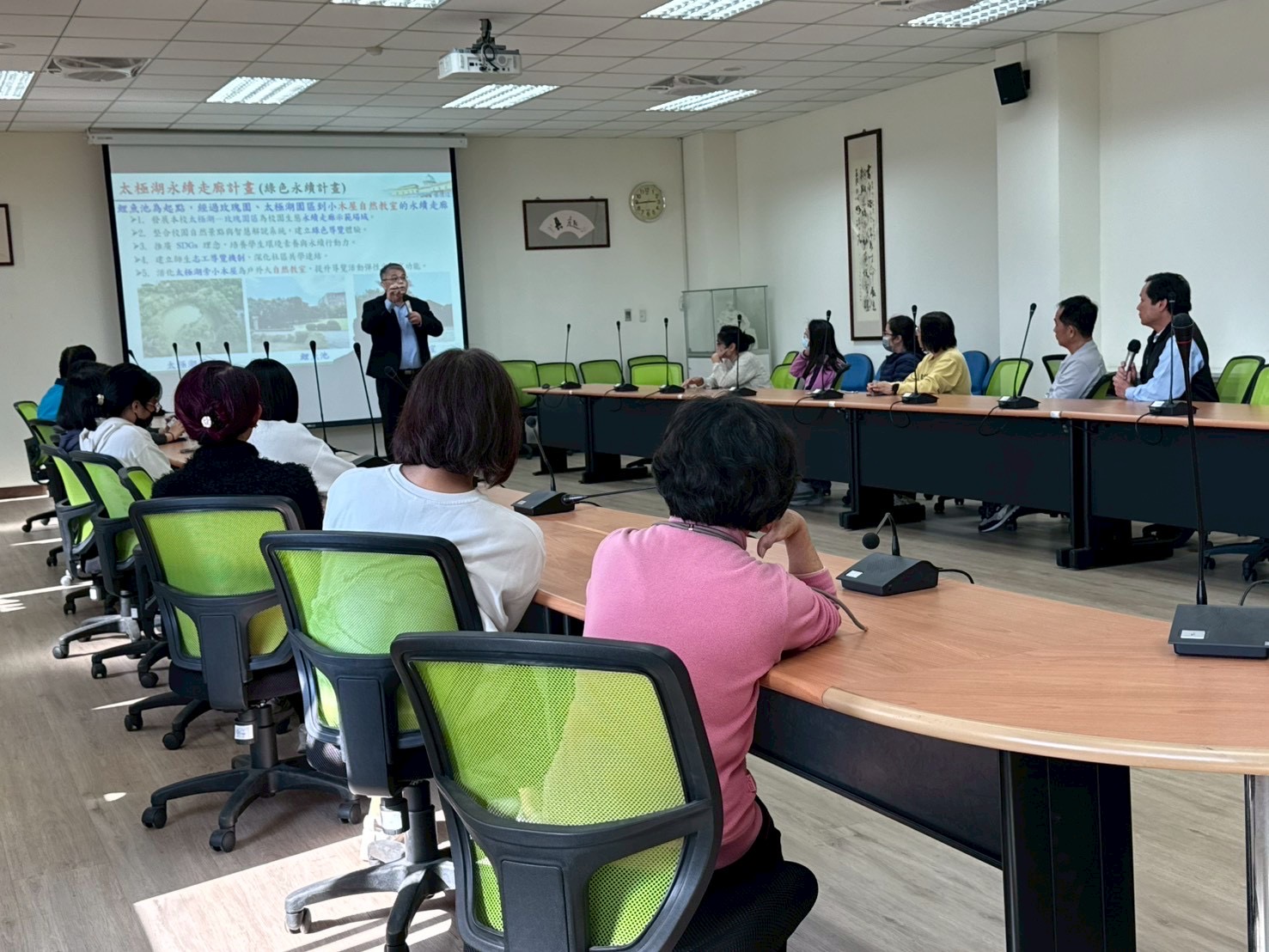
The General Affairs Office of Asia University, together with members of the Semiconductor Center, recently visited National Chung Hsing Senior High School for an academic exchange focused on the integration of semiconductor technologies with sustainable campus development and energy-saving applications. The delegation was led by Mr. Chao-Nan Chen, Chief of General Affairs and a member of the Semiconductor Center, accompanied by Professor Kuei-Yuan Wang from the Department of Finance, also a member of the center.
During the visit, the Asia University team shared practical achievements in applying semiconductor technologies to campus sustainability initiatives. Key examples included the Taichi Lake Sustainable Corridor, the Semiconductor Sustainability Plaza, and projects under the Ministry of Education’s Sustainable Energy-Saving Program. These initiatives demonstrate how semiconductor technologies can be effectively applied to energy management, electricity monitoring, and data-driven analysis within a campus environment.
Mr. Chen noted that Asia University has positioned semiconductor expertise at the core of its sustainability strategy, integrating energy management systems and smart monitoring technologies into real-world campus applications. These sites also serve as instructional demonstration platforms, enabling students to better understand the critical role of semiconductors in smart energy conservation and sustainable development, thereby advancing talent cultivation at earlier stages of education.
The exchange also included in-depth discussions with Director You-Ming Ma of the General Affairs Office at National Chung Hsing Senior High School, along with representatives from the Academic Affairs, Student Affairs, and General Affairs offices. Topics covered campus operations, curriculum integration, and student learning outcomes. Both institutions explored future collaboration opportunities, including curriculum alignment, campus visits, and shared educational resources, to further strengthen semiconductor education cooperation between high schools and universities.
Professor Wang, a sustainability and carbon inventory specialist at Asia University, emphasized that the university will continue to integrate the teaching and research strengths of the Semiconductor Center to promote sustainable campus practices and energy-saving initiatives. Through cross-institutional exchanges and collaboration, Asia University aims to reinforce the semiconductor talent development pipeline—extending education downward while strengthening connections with industry.
