



Asia University Connects Taiwan’s Semiconductor Talent Development with 11 Universities Across Nine U.S. States
Global semiconductor competition has expanded beyond technology and production capacity to encompass talent development. Higher education leaders and scholars representing 11 universities across nine U.S. states visited Asia University (AU) on September 4 as part of the Taiwan–U.S. Semiconductor Education Alliance delegation. The delegation also visited Siliconware Precision Industries Co., Ltd. (SPIL), a global leader in semiconductor packaging and testing, as well as AU’s semiconductor packaging quasi-production line, measurement laboratories, and process laboratories. The visits provided an opportunity to learn how Taiwan integrates university and industry resources to cultivate semiconductor professionals and to discuss potential collaboration in faculty exchange, research, student exchange, and industry internships.
The delegation was organized by the American Association of State Colleges and Universities (AASCU). Teresa Brown, AASCU Vice President for Academic Innovation and Transformation, said the delegation had visited several universities and industry partners in Taiwan during the week. Its visit to AU revealed considerable potential for cooperation between higher education institutions in Taiwan and the United States. In response to the growing global demand for semiconductor professionals, she emphasized that cooperation, rather than competition, is more important than ever. The semiconductor industry has already demonstrated the value of interdisciplinary collaboration, and higher education should establish similarly strong partnerships.
The U.S. CHIPS and Science Act has encouraged renewed investment in semiconductor fabrication facilities and research and development. However, building new facilities does not automatically ensure the availability of a qualified workforce. According to estimates from the Semiconductor Industry Association, the U.S. semiconductor industry is expected to create approximately 115,000 additional jobs by 2030, of which around 67,000 may remain unfilled. The next major challenge for semiconductor development in the United States is therefore whether sufficient talent can be cultivated in time.
During her visit to AU, Brown noted that the close connections between universities and industry in Taiwan were particularly impressive. AU’s proximity to science parks and industrial clusters creates favorable conditions for university–industry collaboration and enables students to gain practical experience through internships. U.S. universities could draw upon Taiwan’s model by expanding industry-supported talent development and paid internship opportunities. Taiwan’s advanced teaching and laboratory facilities could also attract more U.S. students to participate in study and training programs.
Asia University and SPIL have maintained a long-term partnership in semiconductor talent development. Together, they established Taiwan’s first hands-on semiconductor packaging quasi-production line platform within the higher education system and launched the “SPIL Specialized Program: Practical Training in IC Packaging and Testing Equipment.” The program enables students to progress from on-campus practical training to industry-oriented applications, strengthening their technical capabilities and employment competitiveness. During this visit, the delegation toured both SPIL and Asia University, moving from an industrial production environment to a university teaching setting and directly observing Taiwan’s collaborative university–industry model for semiconductor talent development.
Asia University President Jeffrey J. P. Tsai stated that AU hopes its international partners will experience not only the University’s strengths in semiconductor education but also its integration of art and the humanities. AU continues to invest in artificial intelligence, semiconductors, and interdisciplinary talent development. Together with China Medical University, AU has established the China Medical University and Asia University Joint University System, integrating medical and research resources. The AU campus is also home to the Asia Museum of Modern Art, designed by Tadao Ando, while China Medical University is preparing to welcome a new museum designed by Frank Gehry. These resources create an educational environment where technology, medicine, industry, art, and the humanities converge.
AASCU represents more than 500 regional public colleges, universities, and university systems across the United States. During the visit, the two sides discussed short-term study programs, semester exchanges, industry internships, faculty exchanges, and research collaboration. President Tsai said AU will continue connecting semiconductor industry partners, including SPIL, with U.S. university resources, advancing Taiwan–U.S. semiconductor education from institutional visits and dialogue toward substantive joint talent development.
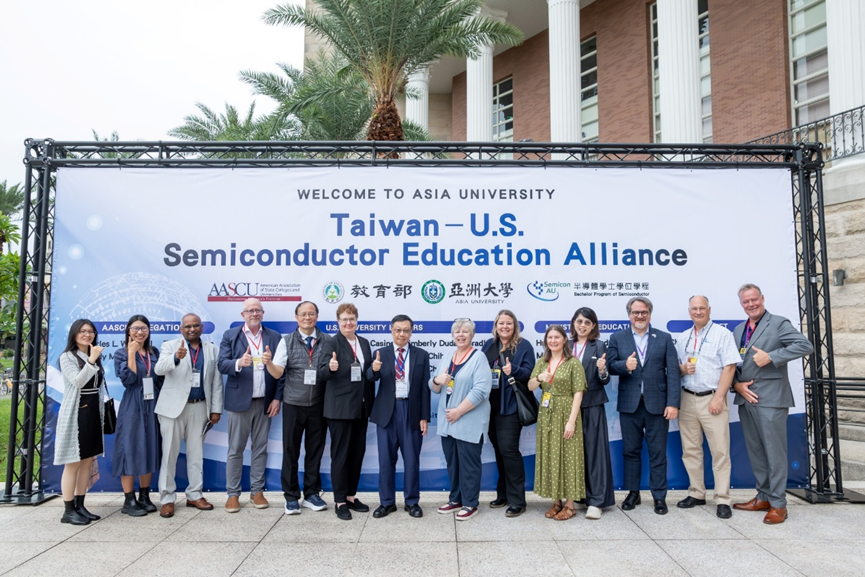
Photo 1|The AASCU delegation poses with Asia University President Jeffrey J. P. Tsai (center), opening new opportunities for Taiwan–U.S. cooperation in semiconductor education.
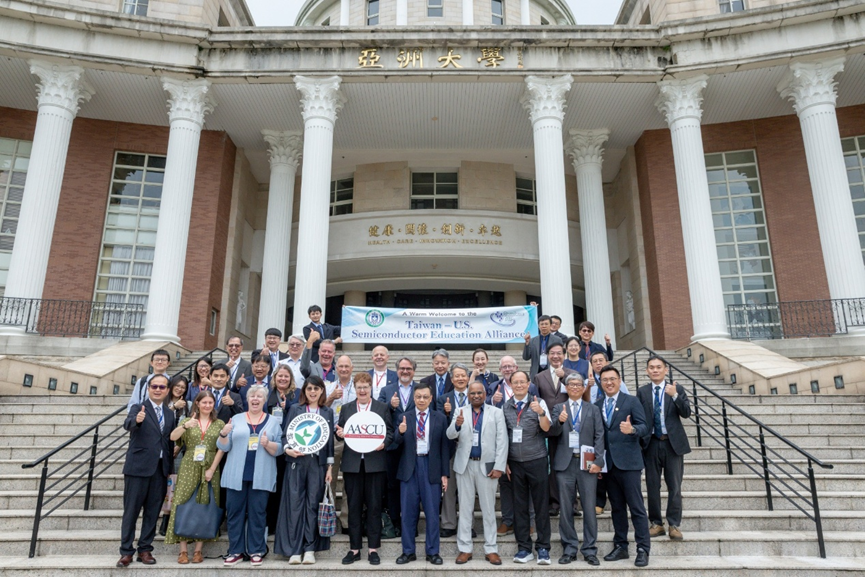
Photo 2|The AASCU delegation visits Asia University and poses for a group photograph with the AU team.
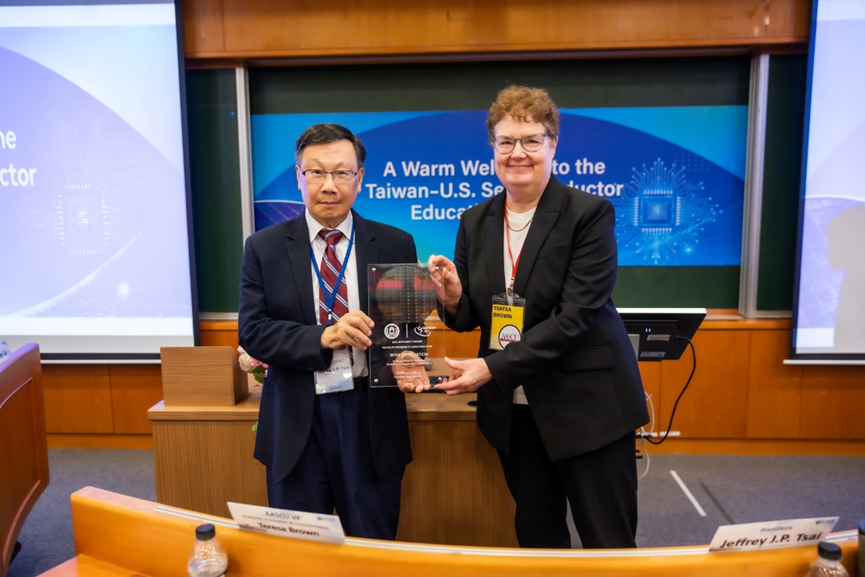
Photo 3|During the delegation’s visit to Asia University, President Jeffrey J. P. Tsai presents commemorative wafers to AASCU Vice President Teresa Brown and other delegation members.
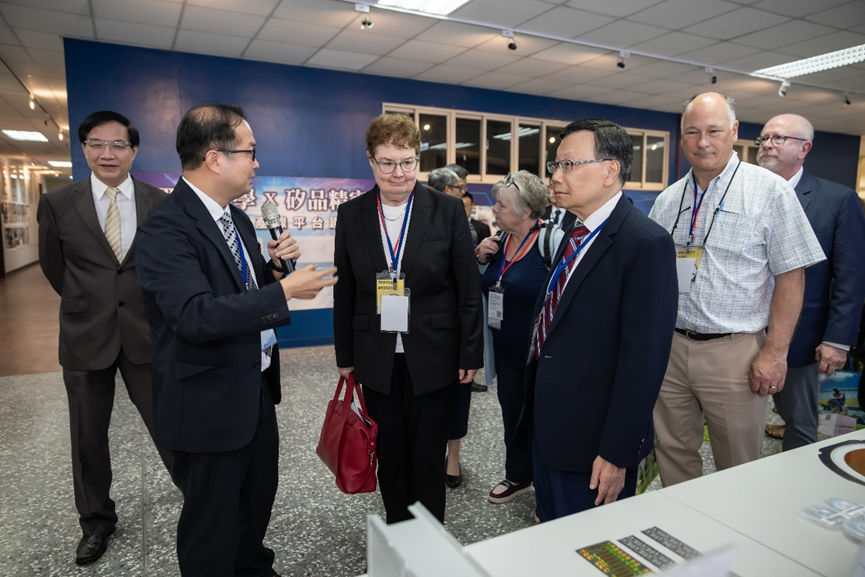
Photo 4|The U.S. higher education delegation visits Asia University and tours Taiwan’s first hands-on semiconductor packaging quasi-production line platform within the higher education system, listening attentively to an introduction to its process technologies and instructional equipment.
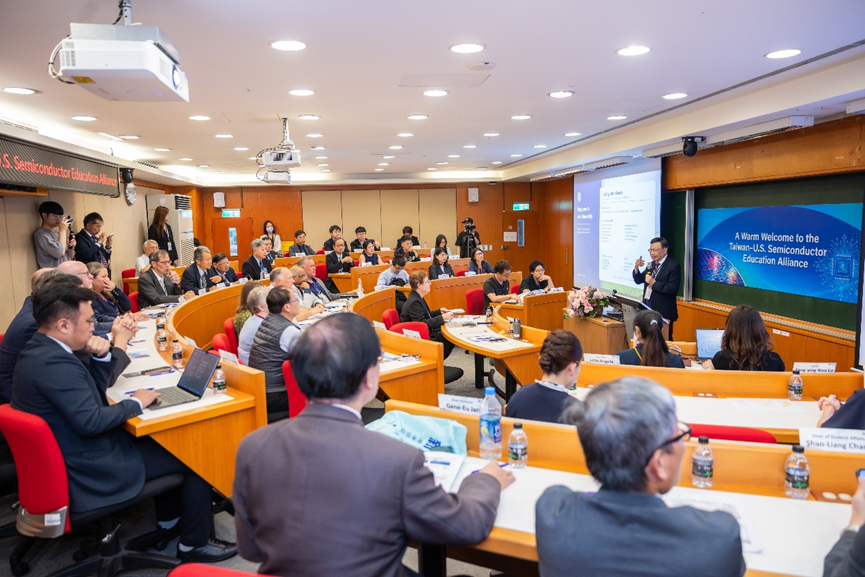
Photo 5|The AASCU delegation and the Asia University team hold a discussion at Harvard Lecture Hall, hosted by President Jeffrey J. P. Tsai.
